Force Feedback
What is Force Feedback (FFB)?
Force Feedback (FFB) refers to the forces generated in peripherals like steering wheels, flight yokes, pedals, etc. that are often used by video games to present simulated forces that approximate the feeling you might experience in real life doing the same activity. You would, for example, feel similar forces from a force feedback wheel in sim racing as you would with a steering wheel in a real car.
How to tell what steering should feel like before getting in the car
Look up the specification for the car's year, make, and model, and note the following:
- Engine
- High power (~500-550 hp) in rear/mid-engine RWD cars can induce power-oversteer (rear steps out on throttle).
- Transmission
- Sequential paddle-shift transmissions provide quick, smooth shifts with minimal jolt compared to manuals or older dog-boxes.
- Steering Lock/Ratio/Rotation
- Lower steering wheel ratios eg. 480deg will feel quicker, sharper, and more direct
- Higher steering wheel ratios eg. 900deg will feel more progressive, smoother, and more stable
- Powersteering
- Powersteering will will moderate force extremes and have a lower baseline strength required in any given driving scenario (straights, corners, esses, banks, etc.)
- Electric and hydraulic powersteering will also have subtly different feel
- Weight Distribution
- Rear-biased (e.g., Porsche 911 GT3 R ~40/60 front/rear) promotes oversteer (loose, rotatable rear, potentially twitchy trailing throttle).
- Front/mid-engine layouts (e.g., Ferrari, Audi) closer to 50/50 or front-biased tend toward understeer (stable, pushes wide at limit).
- Suspension Geometry (caster, camber, toe, anti-dive/squat)
- High positive caster → strong self-centering, stable straight-line feel, heavier effort.
- Negative camber (common) → better corner grip but indirect on-center feel.
- Toe settings → influence turn-in sharpness/stability.
- Anti-dive front geometry → reduces pitch under braking, preserving front grip and steering response.
- Tire size/stagger
- Wider rear tires (standard in GT3) → mechanical oversteer bias (more rear grip mechanically, but power can override).
Tuning Wheel Force Feedback
Tune In:
- Strength
- Friction
- Damper
Tune Out:
- Oscillation
Tips:
- Give filters a try (even if you heard otherwise):
- Do not blindly fear filters. Try them and accept or reject them based on your experience.
- Some unwanted behaviour, such as post-oversteer oscillation, can be reduced or eliminated and more natural steering behaviour achieved by tuning filters such as friction, damper, and inertia.
- Min-Max Technique:
- The Min-Max technique follows the process of trying extreme values, first min, then max, then try the middle of those two, then go up or down from there, always in the middle of the last two values, and keep repeating that process until you find what feels right to you.
- For example, if finding an optimal value between 0 and 100%, you might try 0% first, 100%, 50%, and then, if you want more, you might go to 75%. Then, if you want less, you'd go to 62%. Then, if you wanted more, you'd go to 69%. And so on. In this way, you progressively narrow in on a value that you like the best.
- This technique can be used on any adjustable metric, with a finite range, which has any criteria that tells you that you want more or less of that value.
Gotchas:
- Minimal filters:
- Just enough to tune in what you want and tune out what you don’t.
- Too much filter can potentially numb feedback and may introduce input delay.
- But this doesn't mean you shouldn't try wildly high values, it just means when you do, and you don't like it, then try a middle value and adjust up or down from there, and then repeat that process, until you find what's right for you. This process is called 'min-maxxing' or more technically a form of 'bisection search'.
Resources:
- Force Feedback Myth we Need to Talk About [Video] - Race Beyond Matter (2025) - Another chill video focusing on inertia for reducing oscillation after oversteer. Thought provoking points about trying high inertia values.
- Simucube3 Pro First Proper Drive on My Sim Rig [Video] - Race Beyond Matter (2025) - Chill ffb talk and drive for the new SimuCube 3, valuable FFB knowledge about friction, damper, and oscillations, among other stuff, useful info even if you don't have a SimuCube.
What Real Steering Feels Like At The Wheel
Goal:
- Understand force feedback better by learning what real steering feels like based on handling behaviour in racing cars at racing speeds
What we're trying to understand:
- How a real steering wheel feels in different driving scenarios
- Including weight feel, or arm strength, required to maintain steering control
- And progression of weight increase as tire approaches, enters, and exits understeer
Context:
- Daniel Morad, a real world GT3 professional driver and youtuber, talks about driving more in terms of handling behaviour and less in terms of handling "feel" or "information" like sim drivers often do
- The value of this approach is that you can then break down driving into more manageable, easier-to-understand scenarios
- You will also better understand what to look for, where to look for it on track, and when to look for it on track, which is crucial to optimizing your race craft on the fly
- The following scenarios are broken up in such as way as to isolate handling behaviour so that it can be described concisely and coherently
Straights:
- Steering wheel is light and effortless with minimal resistance; little to no self-aligning torque as tires have near-zero slip angle. It self-centers easily if displaced, requiring almost no arm strength to hold straight.
Low-Speed Corners:
- Steering lighter overall with less resistance; more sensitive to inputs, requiring precise micro-adjustments or "sawing" to rotate the car and probe grip.
- Often favors mild oversteer for quicker direction change; grip loss feels subtler but wheel can lighten abruptly in tight turns.
High-Speed Corners:
- Steering feels heavier and more loaded due to higher lateral forces and (in aero cars) downforce increasing tire load; strong self-centering with stable, progressive resistance.
- Preferred slight understeer for predictability; wheel lightening is a clear warning of limit.
Corner Transitions:
- Entry
- Steering weight builds progressively as you turn in and load the front tires laterally; wheel feels increasingly heavy/loaded due to rising self-aligning torque. Drivers probe with small inputs to feel grip building; onset understeer shows as subtle lightening if entry speed is too high.
- Mid
- At balanced limit: Steady heavy weight with constant resistance; drivers hold fixed input or make micro-adjustments. Wheel feels maximally loaded near peak grip; subtle vibrations may warn of approaching limit.
- Exit
- Weight begins to decrease as you unwind steering and apply throttle (unloading fronts); remains loaded if balanced, but lightens noticeably if throttle-induced understeer occurs. Skilled drivers may induce mild oversteer for rotation, requiring quick counter-steer corrections.
Carousels and Extended Corner Bankings:
- Steering held at fixed angle with sustained heavy weight at limit grip; drivers often make small "sawing" or wiggling inputs to probe and maintain peak front grip without fully losing it. Wheel feels consistently loaded but requires constant micro-corrections to balance as tires heat or load varies.
Understeer:
- Grip build causes steering weight to increase to a peak ("nice heavy feel").
- Mild/onset understeer: Subtle lightening ("less loaded").
- Moderate understeer: Noticeably lighter, reduced resistance despite more lock.
- Severe understeer: Wheel goes almost weightless/limp, feedback "shuts off" as self-aligning torque drops sharply—car pushes wide with minimal self-centering.
Oversteer:
- Primary feel is through seat/chassis rotation ("seat of the pants") rather than direct steering weight change; wheel may lighten slightly as car yaws excessively.
- Requires rapid counter-steer (opposite lock) to catch slide—wheel feels lively during corrections but not as dramatically unloaded as in understeer. Throttle/lift-off often induces it, with drivers balancing via modulation.
Straight-line Heavy Braking:
- Steering remains very light with minimal resistance; may include subtle vibrations or pulls if wheels lock briefly.
Trail-Braking:
- Trail-braking into corners: Weight builds heavily in the wheel as fronts load (increasing self-aligning torque for sharp turn-in); feels loaded and responsive.
- Excessive trail-braking can lighten the wheel subtly if fronts approach limit, or induce rear rotation (oversteer feel more through seat than wheel).
Over Bumps/Kerbs:
- Wheel transmits sharp tugs, kicks, or vibrations directly (especially in non-power-steered or lightly assisted cars); feedback intensifies over rough kerbs, helping drivers judge usable track limits.
- In aggressive kerb use (e.g., apex riding), can cause momentary lightening or pulling if grip varies; drivers probe with small inputs to feel surface changes.
Wet Conditions:
- Overall steering weight significantly lighter due to reduced tire friction and self-aligning torque; feels "slippery" or numb with delayed/muted responses.
- Grip loss (understeer) shows as even more sudden lightening; kerbs/painted lines become treacherous (extreme slips).
- Drivers use gentler, smoother inputs to maintain feel.
Throttle Lift / Lift-Off Oversteer:
- Reducing throttle mid-corner shifts load forward.
- Front tires suddenly feel heavier; rear tires may break traction.
- Wheel feedback changes quickly: heavier, sharper self-aligning torque up front, twitchiness at the rear.
Surface Changes / Grip Transitions:
- Wet, dirty, or icy patches: wheel feels unusually light, almost disconnected.
- Tire grip reduces, self-aligning torque drops, and understeer can appear suddenly.
- Drivers describe it as “floating” or “turning on ice.”
Transient Load Shifts:
- Rapid transitions from left to right (chicanes, esses): wheel weight fluctuates quickly.
- Front tire grip and Self Aligning Torque (SAT) may lag slightly behind load changes, giving a “wobbly” or “floating” feel.
Notes:
Modern GT3 Powersteering Assist and Wheel weight
- tl;dr GT3 powersteering is direct yet smooth, but not numb like a road car, and the powersteering moderates steering wheel weight extremes at the high end so that the wheel feels lighter in high speed (high forces) corners
- Powersteering cars baseline steering wheel weight is lighter therefore weight loss during understeer feels less severe than non-powersteering cars
- Non-powersteering baseline steering wheel weight is heavier therefore weight loss during understeer feels more severe than powersteering cars
Notes:
- Based on Shovas and The Iron Wolf's conversations and on conversations with AI [3]
Wheel weight does not always mean grip and vice versa
- Grip can still increase when steering wheel weight decreases
- Lightening steering in corners does not always mean understeer (which definitely is less grip)
- It is not just about tarmac-rubber grip, it has to do with how steering suspension geometry translates forces into your wheel as well as self-aligning torque which is itself emergent out of other forces, geometry, and other steering variables
- (Race) Car Steering Forces EXPLAINED! [Video] (Theory ~ 14m00s, Practice ~ 17m45s, Demonstration ~ 20m00s) - Niels Heusinkveld (2019)
- How Tire Slip turns into Tire GRIP! - Combined Slip and Grip Explained! (somewhat, possibly) [Video] - Niels Heusinkveld (2020)
Key screens from Niels Heusinkveld's Car Steering Forces Explained video: [4]
-
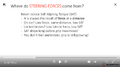 @11m29s
 -
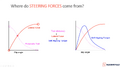 @12m51s
 -
 @14m25s


Pneumatic Trail Parking Lot Forces Drop Off As Felt At Steering Wheel
- tl;dr Pneumatic trail contribution to steering wheel forces drops off, very roughly speaking, from Major to Moderate to Minor at 100km/h +/- 20-50 km/h [Based on AI conversations]
- This impacts how you tune grip weight in FFB configuration such as Game FFB in the PLR and pneumatic trail in CCGEP SF FFB, RealFeel FFB, and Leo FFB
Experiment: Using Leo FFB low speed 'parking lot' fake physics for pneumatic trail effect
- tl;dr Tune Leo FFB low speed 'parking lot' fake physics to drop off at higher speeds when your FFB plugin does not support pneumatic trail real physics
- Caution: Do NOT do this if your FFB already supports pneumatic trail physics. Instead, tune it as intended to drop off at very low speeds (say less than 25km/h) by which speed your FFB's own pneumatic trail real physics will begin kicking in.
- This was probably always a bad idea, even on Leo FFB that didn't support pneumatic trail physics, but was just something I was interested in trying as an experiment.
- In GTR2, with CCGEP Steering Force FFB, pneumatic trail is supported but it disappears at low speed. This is a situation where you would want to enable 'parking lot' fake physics and limit it to a maximum of say 25km/h speeds so that real physics calculations take over very quickly.
Common Force Feedback Issues
Absent or light steering wheel weight in low speed cornering
- tl;dr Real world race car low speed cornering still exhibits mild to moderate steering wheel weight due to self aligning torque, caster handling, and rack friction [5]
- Even some modern sims have had to fix this issue, such as LMU in Early Access (if I recall correctly)
- The problem appears to result from unrealistically fast drop-off of self aligning torque (from tire-road interaction), missing or mis-calculated caster moment physics, and rack friction (although I suspect that's the least important)
Trivia:
- The Iron Wolf has observed that RealFeel FFB exhibits this issue while Leo FFB does not. CCGEP SF FFB also improves behaviour in this scenario.